Pinterest

Popular Posts

FOR SALE House at Lebak Bulus

This Blog is under controlled by Aditya Surya Dharma.

Enduro Matic VS Fastron Techno

This Blog is under controlled by Aditya Surya Dharma.

All New Suzuki GSX 150R 2014

This Blog is under controlled by Aditya Surya Dharma.

Perawatan Transmisi Matic Honda Jazz

This Blog is under controlled by Aditya Surya Dharma.

Honda Mobilio VS Toyota Avanza Veloz

This Blog is under controlled by Aditya Surya Dharma.

Friday, October 25, 2013

Mazda 3 2014

Such was the plight of the previous-generation Mazda 3 four-door sedan and five-door hatchback. The grotesque smile and black-tongued face no mother could adore kept these otherwise excellent compacts from earning the respect they deserved.


Celebrating its 2010 clean break from the Ford Motor Company, Mazda is strutting its small-car stuff with an all-new 2014 3 family designed and developed in-house with no Blue Oval collusion. The four- and five-door bodies are back, sans grinning grilles, on a 2.4-inch longer wheelbase with a 1.6-inch width stretch. The family resemblance to the CX-5 crossover and the 6 flagship sedan is clear, yielding some of the more attractive small cars less than $30,000 will buy.


The five-door is 1.8 inches shorter overall versus the half inch snipped from the four-door. Models with an “i” suffix are powered by a new 2.0-liter four-cylinder, while an “s” signifies a 2.5-liter. Both fours abide by the Skyactiv ethos consisting of variable valve timing, direct injection, a 13.0:1 compression ratio, and a penchant for revs. The little engine’s redline is 6800 rpm while the bored-and-stroked big brother tops out at 6500. Four trim levels are available with the 2.0 and three with the 2.5; factor in the body and engine choices and you’ve got eleven different Mazda 3s to choose from.


The 3i Grand Touring tested here is a middle child with a starting price of $24,040 (versus the basement model’s $17,740) and only four options—a $70 cargo mat, a $100 rear bumper guard, $125 door-trim plates, and a gorgeous metallic paint job costing $300 extra. Standard GT equipment consists of 16-inch aluminum wheels, automatic climate control, a seven-inch touch screen with navigation and a rear camera, and a split-folding rear seat. The GT’s Bose sound system boasts nine speakers, HD and satellite radio, two USB inputs, Pandora, Stitcher, and Aha audio. Bluetooth and SMS message delivery and reply are also standard GT fare.

Shift and Shout

Even with this equipment bounty, our test car weighed a reasonable 2892 pounds. While the spunky 2.0-liter engine is happy at its work, it doesn’t move this package with excessive enthusiasm. The run to 60 took 7.9 seconds with but 87 mph showing on the speedometer during the 16.3-second quarter-mile sprint. You’re justified blaming tall gearing for some of that languor, but without it the stick-shift 3i wouldn’t earn the 40-mpg EPA highway rating essential for competing against compact-class competitors, hybrid or otherwise.


Need more speed? Locking the right pedal to the floor yields an impressive 131 mph, attributable to the five-door’s 0.28 drag coefficient and modest frontal area. Alternatively, you can ante up $3250 to $5000 for a 2.5-liter 3s, which adds 29 horsepower to clip 0.7 second from both zero-to-sixty and quarter-mile times.

The attractively tailored, red-stitched upholstery isn’t real leather, although it would take a lab-grade sniff test to confirm that. Painted plastic and faux carbon-fiber accents included with the Grand Touring trim are equally impressive. While the seven-inch touch screen can be an enigma at times, the ‘Commander’ knob on the console does a reasonable job of mimicking Mercedes-Benz’s COMAND controller at a fraction of the cost. The station tuning and seek switches on the steering wheel are much handier to use than the redundant controls hidden in the screen menus.


This first run through our test gauntlet bodes well for better things to come when the Mazdaspeed performance division turns its attention to the new 3. Replacing the smiley face and Ford flavoring with Skyactiv technology was a brilliant move, worthy of a most improved player award in the brutally competitive compact class.

caranddriver

Wednesday, October 23, 2013

MINI S Paceman 2013

It’s increasingly clear that the product planners at Mini don’t feel constrained by the brand’s name, an attitude that might have been inspired by Humpty Dumpty’s draconian take on definitions. Just before having his great fall, Humpty said, “When I use a word, it means just what I choose it means—neither more nor less.”


The Paceman is the latest proof of the elasticity of the word Mini. Using the elongated architecture that supports the five-door Countryman, the three-door Paceman is about the same size as a Hyundai Veloster—not exactly elephantine, but far from petite. Compared with the base Mini hardtop, still the brand’s bestseller, the Paceman is 15.6 inches longer, 4.0 inches wider, and 4.5 inches taller. And at 3331 pounds, it’s as much as 800 pounds heavier.


Performance Math

The engines available in the Paceman are the same three variations of the 1.6-liter four employed across Mini’s entire product line—one naturally aspirated, two turbocharged. The sum of their specifications doesn’t add up to blazing performance, especially with the optional ($1250) six-speed Steptronic automatic transmission fitted to our test car. Even with the automatic in manual mode, the shifts are deliberate, but not a performance asset.

Propelled by the milder of Mini’s two 1.6-liter turbos (181 horsepower, 177 lb-ft), our Cooper S Paceman ALL4 (as in four-wheel drive) required 7.3 seconds to reach 60 mph, covered the quarter-mile in 15.7 seconds at 89 mph, and consumed 21 seconds reaching 100 mph. Contrast those results with the numbers we wrung from a Cooper S hardtop: 0 to 60 in 6.2, the quarter-mile in 15.0 at 95, and 0 to 100 in 16.7. And the 1.6 turbo in that Cooper S was rated for 172 horsepower; the additional nine ponies came later.


Inevitably, mass will have its say in matters of acceleration and general dynamics. Adding several hundred pounds to the equation mitigates transient response, although in this area the distinctions become less tangible. The Paceman is heavier and taller, but it has the moves and feel that help set Minis apart from the herd. The king-size Mini might not be quite as quick on its feet as its smaller counterpart, but the fun-to-drive factor—limited body motions; quick, tactile steering; a gratifying sense of connection with the car—is undeniably present.


The downside of this last point is something common to all Minis. The stiff springs, the aggressive damping, the hard bushings, and the low-profile run-flat tires (Pirelli P Zero 225/40-19s) provide respectable grip (0.86 g) and okay braking (169 feet from 70 to 0 mph), but at the expense of ride quality that doesn’t take much uneven pavement to become seriously abrupt.

EPA fuel-economy ratings aren’t great for such a small car, at 23 mpg city and 30 highway. We achieved 24 mpg over 684 miles.

Size Matters

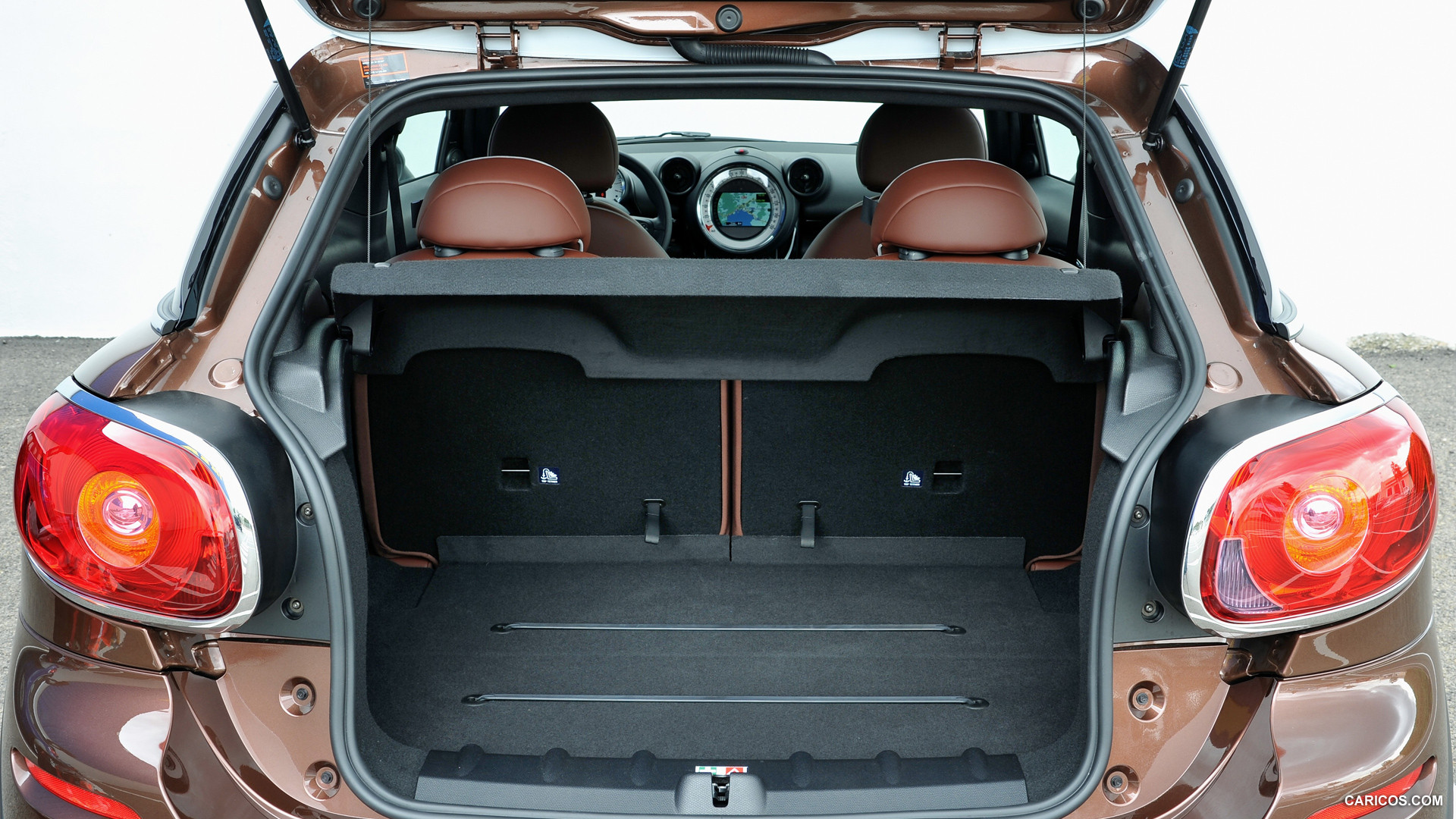
But if the Paceman gives something away to the hardtop in terms of performance, it does have some advantages. Specifically, there’s room for a pair of adults to reside comfortably in the rear seats. Try cramming a pair of your pals into the rear of a hardtop Mini, and see how long they continue to like you. The hardtop’s rear seat is essentially a parcel shelf. In the same vein, the Paceman offers substantially more cargo room, with 11.7 cubic feet behind the rear seats and 38.1 cubic feet with the rear seats folded flat. So if utility is an issue, the Paceman delivers.


Beyond that, the Paceman is one of just two Minis to offer the brand’s ALL4 all-wheel-drive system (the Countryman is the other).

Arguably, if utility is the objective and the prospective buyer wants to stay within the Mini family, the Countryman, with its extra set of doors, makes more sense. On the other hand, if style tops the list of priorities, then the Paceman has a definite edge in visual cool versus its five-door cousin. The three-door preserves the proportions, rising beltline, and sloping roof of the hardtop on a bigger scale, with its own interpretation of the Mini grille and a going-away view dominated by a set of oversize round taillights.


caranddriver

Review Suzuki Swift 1.4

Not long since his return to Indonesia at the end of 2012, the figure is now the latest generation Suzuki Swift is a lot we meet on the streets of Greater Jakarta and other cities in the archipelago. Yes, that's the best response to the Indonesian market newcomers in the hatchback segment. It is not only experienced by Swift, but also by its rivals such as the Hyundai Grand Avega 1.4, Ford Fiesta 1.4, KIA Rio 1.4 and Chevy Aveo.


Especially if the main reason is not because of the cars in this segment offers an attractive design, adequate performance, economical fuel consumption, and the price is relatively affordable. So also with its compact dimensions and further confirms its nature as an urban car. And the most important is the design of digandruingi many young drivers.

This is why many manufacturers who participate lowering products in this segment. Then what is the mainstay of the latest generation Suzuki Swift hatchback market to break this growing demand?

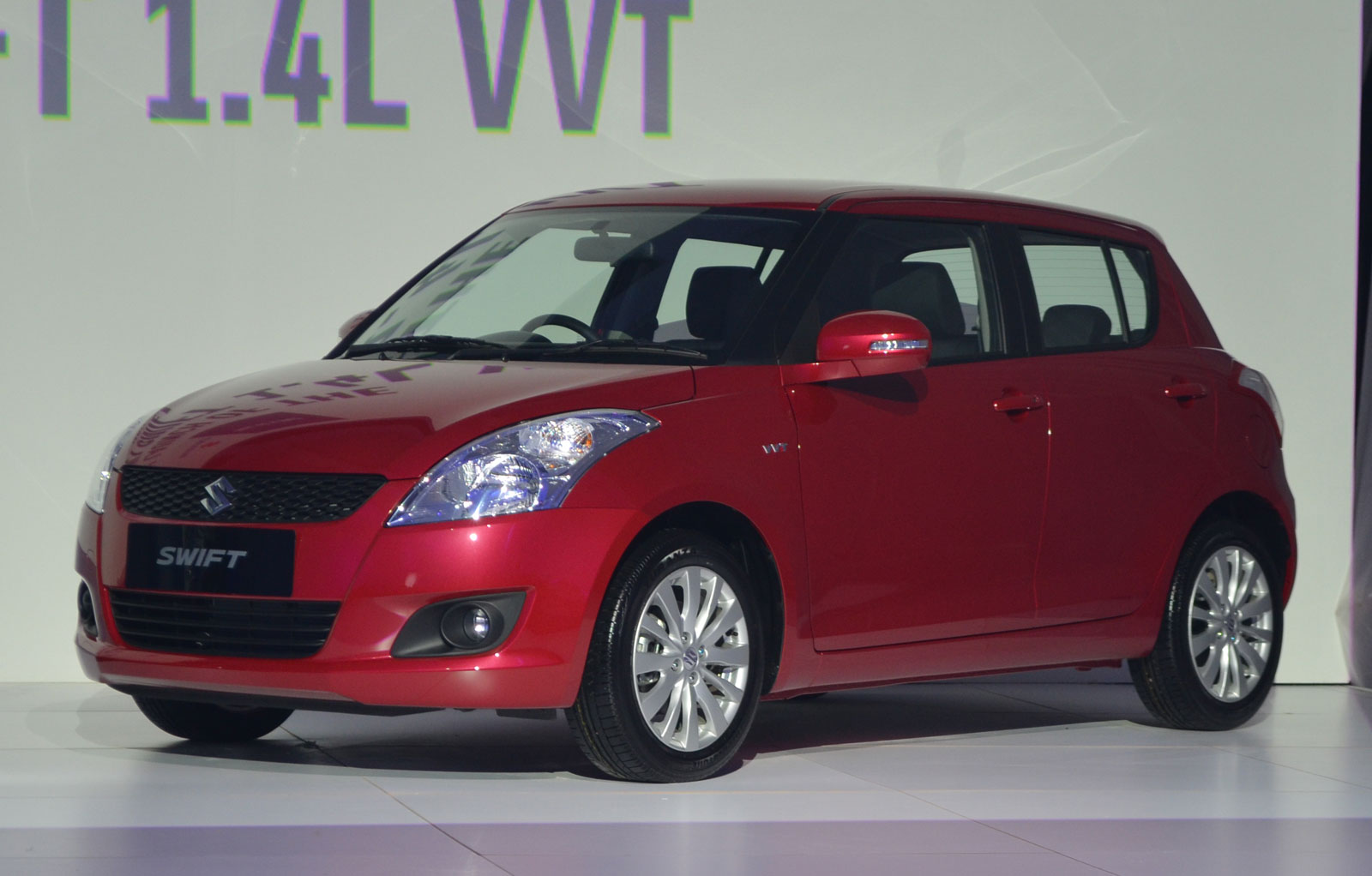
Although all components of the platform and the car was new, but this latest Swift still looks very similar to the old one. In fact, when viewed at a glance when the car was speeding, almost difficult to distinguish from the previous generation. The owners of Swift Swift is like the previous figure, it is the reason Suzuki maintains almost the same shape it.

Previous generation Swift has been known as a good-looking car with a roof that sharp, like a knife, plus a black front pillar. However, because this car is a generation that is really new, of course, are required to be able to display the Suzuki Swift design is also impressive new, with the old design considerations so diminaticharus carried over into the next generation. This is why the evolution of the design is done with great caution.


Her face became more refreshed headlight design with longer and more curved look. Similarly, back, side trunk opening is made higher in order to support the robustness of the structure. Design rear combination lamps are also made ​​to be more - fused with the body contour. House mirrors have now been equipped with turn signal. Finally, all four wheels now appear more sporty design with a new 16-inch alloy wheels.

The rest, all new Swift just look fatter and bigger dimensions present the results of a longer 155 mm, and 5 mm wider than its predecessor. Evolution minimalist design is expected to attract more consumers to choose the new Swift.

The platform used is the same platform used - with Suzuki Ertiga. That is, the Swift has a level of NVH ( noise , vibration, harshness ) which is similar to his Big brother 's. Structure made ​​of steel it is also equipped with side impact beams to protect against side impact.

This time its power is generated from a rather unusual source. When Swift previously offered with a 1.5 liter engine, now Swift is only coded K14B engine equipped with a capacity of 1.4 liters. Strength decreased from 100 hp to 95 hp and a peak torque of 133 Nm also reduced to 130 Nm. However, the engine is also used in the Ertiga is claimed to be more fuel efficient.

Just like the previous model, the Swift still uses McPherson struts front suspension and torsion beam with coil behind. The damping system is also used on its twin, Ertiga. So even with a 4 - speed automatic transmission is a transmission that used the same as those used in the Ertiga matic has just been released.

Suzuki Swift now has a length of 3,850 mm. This length is approaching the latest Honda Jazz ( 3,920 m ) and the Chevy Aveo ( 4,031 mm ). So, this car should have been able to give the cabin area of ​​the competitors.


But in fact, the maximum back-row legroom is only 630 mm. Indeed, 5 - passenger hatchback can accommodate three adults in the back seat, but they are more comfortable if the back row is filled by three children or adolescents, because lower roof makes the cabin rear headroom ( 820 mm ) to be more limited.

The same was seen in the trunk. Luggage capacity of 204 liters is not exactly great, even when the second row seats folded though. More than that, the rear seats can not be folded up flush with the surface of the trunk floor.

Baggage door openings are small little difficult access accommodation goods. Indeed, for a supermini size, no rival Honda Jazz luggage capacity ( 399 liters ).

Luckily, Swift cabin soundproof is excellent. Quality of NVH ( noise , vibration, harshness ) is a mainstay Ertiga, also can be felt from the Swift cabin is quiet. Why, minimal vibration K14B engine that sits on rubber pads and is positioned away from the firewall. As a result, engine vibration is reduced succeeded well, as well as with his voice not so audible from inside the cabin. It's just that at high speed, voice articulation tires sized 185/55 R16 are still investigating into the cabin.

Which is also enjoyable Swift is the quality of the cabin interior materials . Plastic material used is better than its competitors . The design is neat and simple , not a lot of instruments and a scattering of buttons on the dashboard .

Meter cluster of interest is now also equipped with multi- information display ( MID ) that can display full information about mileage , fuel consumption , air temperature outside the cabin , until the hour indicators .

Swift is now also features automatic air conditioner . So even with the head in- dash audio unit that is equipped with audio control switches on the steering wheel , and come equipped with a USB socket .


Swift is not equipped with leather seats. However, the thick seat cushion with back support is quite comfortable when occupied for a long time. Availability seat adjuster and adjustable steering wheel makes it easy to find the position of driving.

Storage compartment provided was plentiful with a wide center console, bottle holders in each door, and a large glovebox . Increased convenience features come with the presence of start-stop button . Safety features include dual airbags for front passengers .

95 hp does not sound too great . Maximum torque of 130 Nm is also just , but the rate is higher than the Ford Fiesta 1.4 liter ( 128 Nm ) .

Suzuki admits that despite lower energy depot capacity of 1.5 liter form the 1.4 liter , but the performance of the engine is no less than its rivals . Evidently, Swift managed to drag from rest to the 100 kph in 13.0 seconds . 1.7 seconds faster than the Ford Fiesta 1.4 which recorded 14.7 seconds . In fact , Swift lost only 0.4 seconds from the Toyota Yaris larger 100 cc engine .

K14B engine has been using drive -by-wire technology and has the dimensions of a ring - cash and lightweight . Not only the engine , Suzuki even replace the radiator fan made ​​of metal with a plastic . Total weight of the vehicle from the previous generation was reduced to 75 kg . This achievement is also supported by a new frame structure that is lighter but more rigid .

That is, power and torque are reduced , managed to offset the weight of the vehicle decreased significantly.

4 - speed automatic transmission with gear ratios are tight enough to contribute to channel power from the engine vigorously . Is typical of such transmission is very supportive of the distinctive character of Swift and nimble , but the beat is generated at every turn of his teeth enough reducing comfort .


Meanwhile , rests ventilated disc brakes in front and solid discs at the rear . As a result, the car can stop from a speed of 60 kph in 2.2 seconds and a distance of 15.8 meters . Brake Swift also is equipped with ABS and EBD .

Engine
Installation Front
Type K14B, DOHC, VVT 4 inline 1.372 cc
Bore/stroke 73,0 x 82,0
Compression ratio 1:10
Power 95 hp@ 6.000 rpm
Torque 130 Nm @ 4,000 rpm
Power to weight 95,1 hp/ton
Torque to weight 130,1 Nm/ton

Type  Front Wheel Drive
Gearbox Otomatis, 4-speed

Length 3.850 mm
Width 1.695 mm
Height 1.510 mm
Wheel base 2.430 mm
Ground clearance 140 mm

Chassis
Construction Monokok
Weight 1.000 kg
Wheels 185/55R16
Tyres R16

Suspension
Front McPherson Strut + Coil Spring
Rear Torsion Beam + Coil Spring

Type  Electronic Power Steering

Brakes
Front Ventilated disk
Rear Disc
Anti-lock ABS, EBD,

Performa
0-20     1,4 second
0-40     3,4 second
0-60     5,8 second
0-80     9,0 second
0-100 13,0 second

Fuel Consumption
City 16,4 kpl
Highway 20,3 kpl